Programme details
What you will study
Programme Objectives
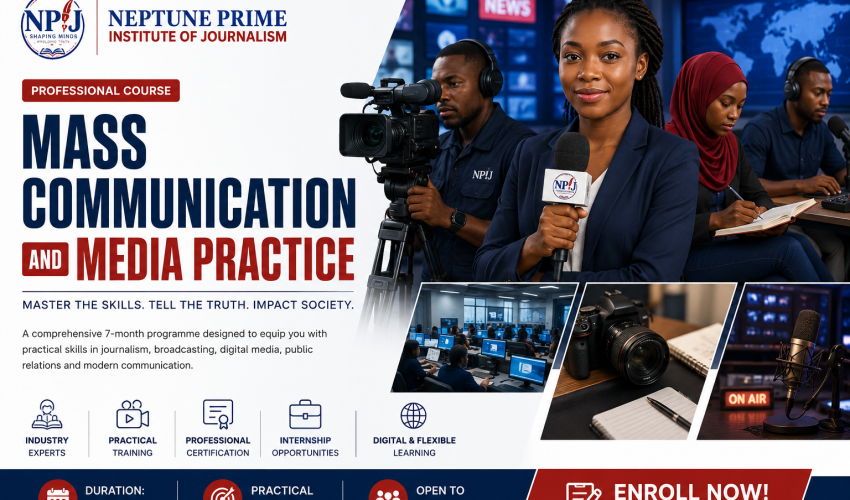
The Certificate in Mass Communication and Media Practice is designed to provide a practical and professionally oriented foundation for individuals seeking careers in journalism, broadcasting, public relations, digital media, corporate communication, and related fields. The programme combines academic knowledge with intensive practical experience to prepare graduates for employment or further study in the rapidly evolving media industry.
Upon completion of the programme, graduates will be able to:
- Understand the principles, ethics, and legal framework governing journalism and mass communication in Nigeria.
- Apply professional writing, editing, reporting, and communication skills across print, broadcast, and digital media platforms.
- Use journalism and communication as tools for development, community engagement, and national development.
- Demonstrate responsible, ethical, and conflict-sensitive media practice.
- Produce professional multimedia content using contemporary digital publishing tools.
- Develop entrepreneurial skills for careers in media, communication, and content production.
- Prepare for progression into the Diploma in Journalism and Media Studies or related higher-level media programmes.
Programme Structure
The programme runs for seven (7) months and is organised into two academic semesters with an industry internship integrated between both semesters.
Semester One
Foundations of Mass Communication
Students build a strong academic foundation in journalism, communication theory, development communication, media ethics, language, and national integration.
Core study areas include:
- Introduction to Journalism
- Media Law and Ethics
- Development Communication
- English for Journalism
- Nigerian Peoples and National Unity
- Language Elective
Industry Internship
Between both semesters, applicants undertake supervised professional training within Neptune Prime's newsroom or approved media organisations.
The internship allows applicants to:
- Observe newsroom operations
- Participate in editorial meetings
- Produce real media content
- Gain workplace experience
- Develop professional confidence
Semester Two
Applied Mass Communication Skills
The second semester focuses on intensive practical media training, including:
- News Writing
- Editing
- Newspaper Production
- Digital Publishing
- Public Relations
- Media Management
- Entrepreneurship
- Capstone Media Production Portfolio
Practical Learning Experience
Learning extends beyond the classroom through extensive practical activities designed to prepare applicants for professional media environments.
Students will participate in:
- Newsroom simulations
- Practical news writing workshops
- Editorial exercises
- Digital publishing
- Multimedia storytelling
- Newspaper production
- Public speaking
- Content management systems
- Media entrepreneurship activities
- Capstone media production project
- Supervised professional internship
Students are exposed to real editorial workflows and contemporary newsroom practices throughout the programme.
Learning Outcomes
Graduates of this programme will be able to:
Knowledge
- Explain the history and evolution of journalism and mass communication.
- Demonstrate knowledge of media ethics, media law, and professional standards.
- Understand development communication and its role in national development.
- Explain Nigeria's media landscape and digital communication environment.
Professional Skills
Graduates will be able to:
- Write professional news stories and feature articles.
- Conduct interviews and verify information.
- Edit and proofread media content.
- Produce newspapers and digital publications.
- Publish content using modern Content Management Systems.
- Produce multimedia journalism content.
- Manage organisational communication.
- Apply public relations principles.
- Develop media business ideas.
Professional Values
Graduates will demonstrate:
- Ethical journalism
- Professional integrity
- Accuracy and fairness
- Respect for diversity
- Social responsibility
- Commitment to lifelong learning
- Development-oriented communication
Career Opportunities
Graduates may pursue careers as:
- Reporter
- Correspondent
- News Writer
- News Editor
- Digital Journalist
- Online Publisher
- Media Officer
- Public Relations Officer
- Communication Officer
- Social Media Manager
- Content Creator
- Copy Editor
- Newspaper Production Assistant
- Corporate Communications Executive
- NGO Communication Officer
- Media Entrepreneur
- Community Media Practitioner
- Government Information Officer
The programme also serves as a progression pathway to the Diploma in Journalism and Media Studies.
Who Should Apply?
This programme is suitable for:
- Secondary school graduates (SSCE holders)
- Aspiring journalists
- Media enthusiasts
- Content creators
- Public relations practitioners
- Government information officers
- NGO communication staff
- Working professionals seeking media skills
- School leavers preparing for careers in journalism
- Individuals seeking practical communication skills
No previous journalism experience is required.
Teaching Methodology
The programme adopts a learner-centred and practice-oriented teaching approach.
Teaching methods include:
- Interactive lectures
- Practical workshops
- Newsroom simulations
- Group discussions
- Case studies
- Multimedia demonstrations
- Writing laboratories
- Project-based learning
- Continuous assessment
- Industry internship
- Professional mentoring
- Portfolio development
Learning is delivered through Physical, Hybrid, and Online modes to accommodate diverse learners.
Neptune Prime Advantage
The Neptune Prime Institute of Journalism benefits from the experience, infrastructure, and professional network of Neptune Prime, one of Northern Nigeria's leading online newspapers.
Students benefit from:
- Exposure to a functioning digital newsroom
- Learning from experienced editors and journalists
- Practical newsroom simulations
- Real editorial workflow experience
- Industry-standard media production practices
- Professional mentorship
- Internship opportunities
- Access to current media case studies
- Networking with practicing media professionals
This unique integration enables applicants to gain practical experience while studying and prepares them for immediate entry into the media industry
Entry Requirements
Applicants should possess one or more of the following:
- Senior Secondary School Certificate (SSCE)
- WAEC
- NECO
- NABTEB
- Equivalent recognised qualification
Applicants with relevant work experience in media or communication may also be considered where applicable.
Admission Requirements
Applicants are expected to provide:
- Completed application form
- Passport photograph
- Educational qualifications
- Valid means of identification
- Birth certificate or declaration of age (where applicable)
- Contact information
- Other supporting documents requested during admission
Admission is subject to verification of submitted information.
How To Apply
Applying for admission is simple.
Step 1
Complete the online application form.
Step 2
Upload all required supporting documents.
Step 3
Submit your application.
Step 4
The Admissions Office reviews your application.
Step 5
Successful applicants receive an admission notification together with enrolment instructions.
Step 6
Complete registration and begin your academic journey.
Applicants can monitor their admission status through the admissions portal.
Programme Features
- Duration: 7 Months
- Study Mode: Physical, Hybrid & Online
- Award: Professional Certificate
- Credit Units: 33
- Semesters: 2
- Internship: Included
- Capstone Project: Included
- Practical Classes: Extensive
- Lessons: 80+
- Assignments: 25+
- Projects: 12+
- Quizzes: 20+
- Certificate: Awarded upon successful completion
- Industry Exposure: Neptune Prime Newsroom
- Progression Pathway: Diploma in Journalism and Media Studies
- 15 Sections
- 30 Weeks
- GST 111 - Nigeria's People, Culture and National UnityJMS 101 - Introduction to Journalism and Media Studies0
- JMS 101 - Introduction to Journalism and Media Studies0
- JMS 102 - Principles of Journalism, Media Law, Ethics and Regulation0
- JMS 103 - Fundamentals of Development Communication Media0
- JMS 104 - English for Journalism0
- LNG 101 - Language Elective I — Select one from: Arabic / French / Farsi / Chinese / Hausa0
- Semester 1 Assessment0
- JMS 201 - News Writing and Editing0
- JMS 202 - Media Management and Operations0
- JMS 203 - Digital Literacy0
- JMS 204 - Newspaper Production0
- JMS 205 - Principles of Public Relations and Advertising0
- ENT 201 - Entrepreneurship and Media Innovation0
- JMS 206 - Capstone Practicum — Media Production Portfolio0
- Final Examination0

Hassan Gimba is an accomplished Nigerian journalist, author, public affairs commentator, publisher, and media entrepreneur with decades of experience in journalism and public communication. He is the Founder of Neptune Prime Institute of Journalism, an institution dedicated to developing the next generation of ethical and professional journalists and media practitioners.
Born on April 1964 in Kaduna, Nigeria, Hassan Gimba has built an outstanding career in print, digital, and broadcast journalism. He previously served as Editor of Leadership Newspaper and was also the Spokesperson to the Honourable Minister of Science and Technology, where he contributed to government communications and public engagement.
He is the Publisher and Editor-in-Chief of Neptune Prime (www.neptuneprime.com.ng), a leading Nigerian online newspaper headquartered in Abuja, as well as Neptune Prime Hausa (www.neptuneprimehausa.com). He also publishes the Neptune Prime Magazine (print edition) and owns Neptune Prime Online TV, demonstrating his commitment to quality multimedia journalism.
Beyond publishing, Hassan Gimba is a respected syndicated columnist whose articles regularly appear in Blueprint Newspaper, New Nigerian Newspaper, and several other national and international media platforms. His writings focus primarily on politics, democracy, good governance, national security, peacebuilding, and socio-economic development, with particular attention to insurgency, terrorism, and armed banditry in Northern Nigeria.
Over the course of his career, he has authored more than 1,000 articles, earning recognition for his insightful analysis, balanced reporting, and commitment to responsible journalism. His published works include The Arbiter, with two published volumes, a collection of selected articles reflecting his views on governance, leadership, public policy, and national development.
Through the Neptune Prime Institute of Journalism, Hassan Gimba continues to mentor aspiring journalists, promote media excellence, and champion ethical reporting in the digital age.
Areas of Expertise
Journalism and Media Practice
Investigative and Political Reporting
Public Affairs Commentary
Media Entrepreneurship
Digital and Online Publishing
Editorial Leadership
Public Communication
Governance and National Security Analysis
Journalism Education and Mentorship
Professional Highlights
Founder, Neptune Prime Institute of Journalism
Publisher & Editor-in-Chief, Neptune Prime
Publisher, Neptune Prime Hausa
Publisher, Neptune Prime Magazine
Owner, Neptune Prime Online TV
Former Editor, Leadership Newspaper
Former Spokesperson, Federal Ministry of Science and Technology
Author, The Arbiter (Volumes I & II)
Author of over 1,000 published articles
You might be interested in